Phonometrica
Overview
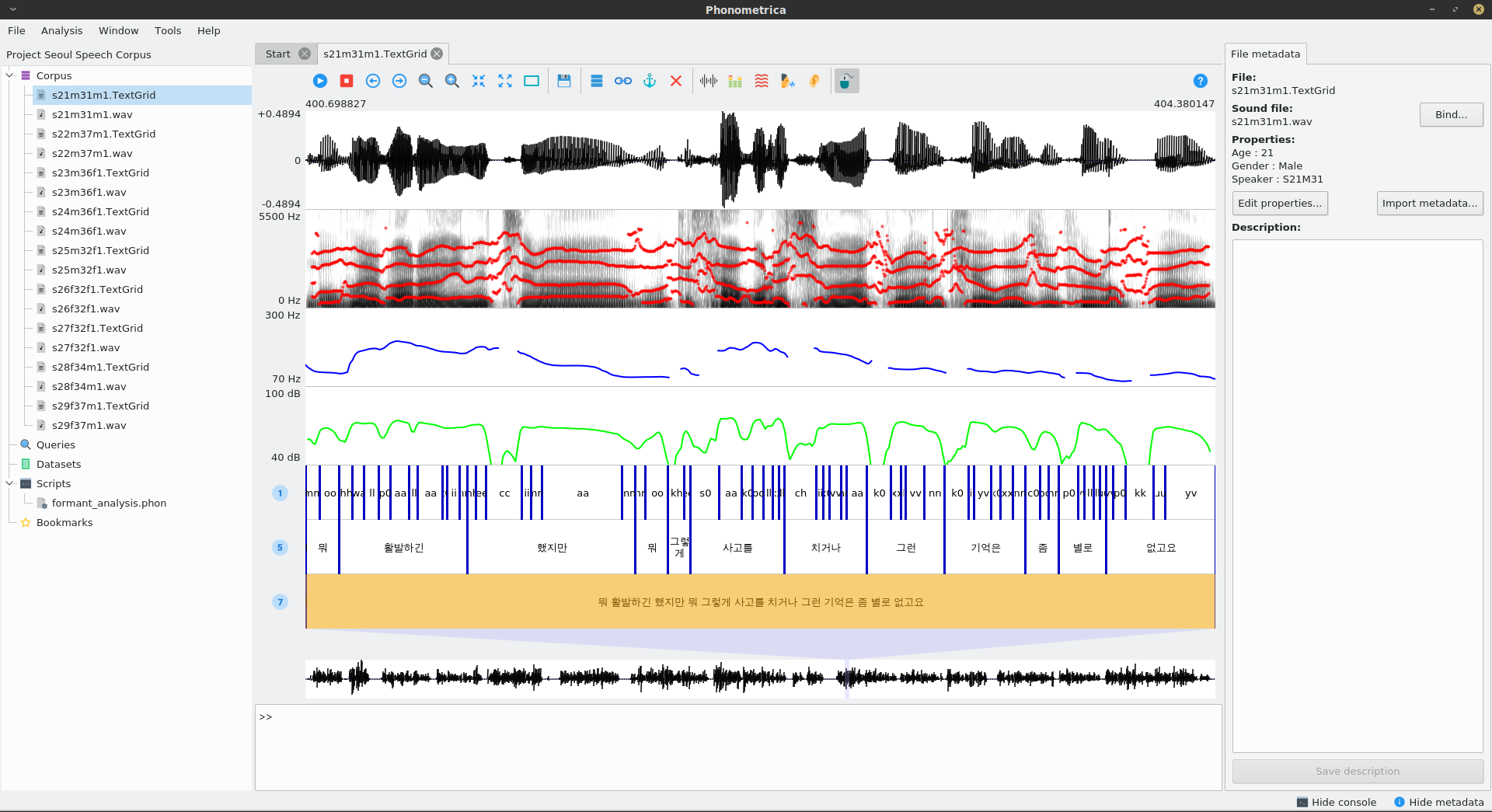
Phonometrica is a free, open-source software platform for the annotation and analysis of speech corpora. It offers a user-friendly interface to manage, annotate, analyze and query language corpora. It is particularly well suited for dealing with time-aligned data, and integrates corpus management, acoustic analysis, and statistical modeling into a single workflow. The main features it offers are:
Project management: organize files into projects with extensible metadata (properties).
Sound visualization and analysis: visualize waveforms, spectrograms, pitch tracks, glottal pulses, formant tracks, intensity curves, spectral slices.
Sound annotation: create and edit multi-layer annotations based on annotation graphs; import and export Praat TextGrids.
Speech processing: detect silences to pre-segment recordings for manual annotation; automatic speech recognition via whisper.cpp (runs locally on CPU, requires a model file).
Text and acoustic queries: search for text patterns across annotation layers using simple or complex multi-constraint queries; extract duration, formant, pitch, voice quality, intensity, and spectral moment measurements.
Concordance and dataset views: browse, filter, recode, transform, and merge query results; vowel normalization (Lobanov, Nearey, Watt & Fabricius); toggle between wide and long formats; perform set operations on concordances.
Statistical analysis (preview): frequentist and Bayesian linear, logistic, Poisson, negative binomial, beta, and robust Student t regression models, including mixed-effects models and support generalized additive models (GAMs); post-hoc and diagnostic tests; exploratory visualizations. These features are extensively tested against reference implementations in R, but are offered as a preview: see Statistical analysis for what that means and for the cases where exporting to R remains the better choice.
Scripting engine: Phonometrica can be configured and extended with a powerful and easy-to-use scripting language, JSON-based plugins, and coding protocols.
Research notes: keep free-form rich-text notes alongside your data, organized within the project.
Standard-based: Phonometrica files are encoded in XML and Unicode.
Interaction with Praat: Phonometrica can read and write TextGrid files and open files directly in Praat from the file manager and concordance views.
Phonometrica runs on all major platforms (Windows, macOS and GNU/Linux) and is freely available under the terms of the GNU General Public License (version 3). The latest version can be downloaded from http://www.phonometrica-ling.org. The source code is available at https://github.com/jeychenne/phonometrica. If you have questions, problems, or would like to report a bug, please contact us at julien.eychenne@usherbrooke.ca.
Download
Phonometrica 0.9.8
Windows: setup_phonometrica.exe
macOS (ARM): Phonometrica-0.9.8.dmg
macOS (Intel): Phonometrica-0.9.8-intel.dmg
Linux (Debian/Ubuntu): phonometrica-0.9.8.deb
source code: phonometrica-0.9.8.zip | phonometrica-0.9.8.tar.gz
Documentation
Phonometrica’s documentation is available from its website file. It is also accessible from within the application via the Help menu and help buttons available in each view.
Topics
- Installation
- Getting started
- Preferences
- Sound visualization and analysis
- Sound annotation
- Speech
- Queries
- Concordances
- Datasets
- Vowel normalization
- Statistical analysis
- Column transformations
- Research notes
- Praat integration
- Keyboard shortcuts
- Scripting
- Plugins
- License
- Acknowledgements
- Release notes
How to cite
To cite Phonometrica, please use the following reference [EYC2025]:
Eychenne, Julien & Léa Courdès-Murphy (2025). Annotation et analyse de données sociophonologiques sur grands corpus : présentation de la plateforme Phonometrica. In Wim Remysen & Hélène Blondeau (eds.) (Re)donner la parole aux corpus montréalais : Regards rétrospectifs et prospectifs. Montreal: Presses Universitaires de Montréal, pp. 255–270.
You may also cite the earlier conference paper [EYC2019]:
Eychenne, Julien & Léa Courdès-Murphy (2019). Phonometrica: an open platform for the analysis of speech corpora. Proceedings of the Seoul International Conference on Speech Sciences 2019, Seoul National University, pp. 107–108.